A new question, before the answer is finished
The user interrupts an answer about smartphones to ask about smartwatches. D2 yields, listens, and answers the new question.
User · leftD2 · right
Anonymous research demo
Listen while speaking. Respond when the user finishes. Yield to an interruption.
D2 brings continuous interaction to pretrained spoken language models.
Qwen3-Omni LLaMA-Omni 2
Qwen3-Omni-D2, 80 ms chunks · Paper Tables 1–2. Evaluation scope and latency definition ↓
01 / Listen
Recorded model outputs.
No microphone or sign-in needed.
The user interrupts an answer about smartphones to ask about smartwatches. D2 yields, listens, and answers the new question.
Use headphones for stereo: user on the left, model on the right. Both waveform lanes animate from the actual speech amplitude. These curated recordings preserve the original timing and overlap; they illustrate behavior, not live latency.
02 / Method
Two stages turn a pretrained half-duplex model
into a model that listens and speaks continuously.
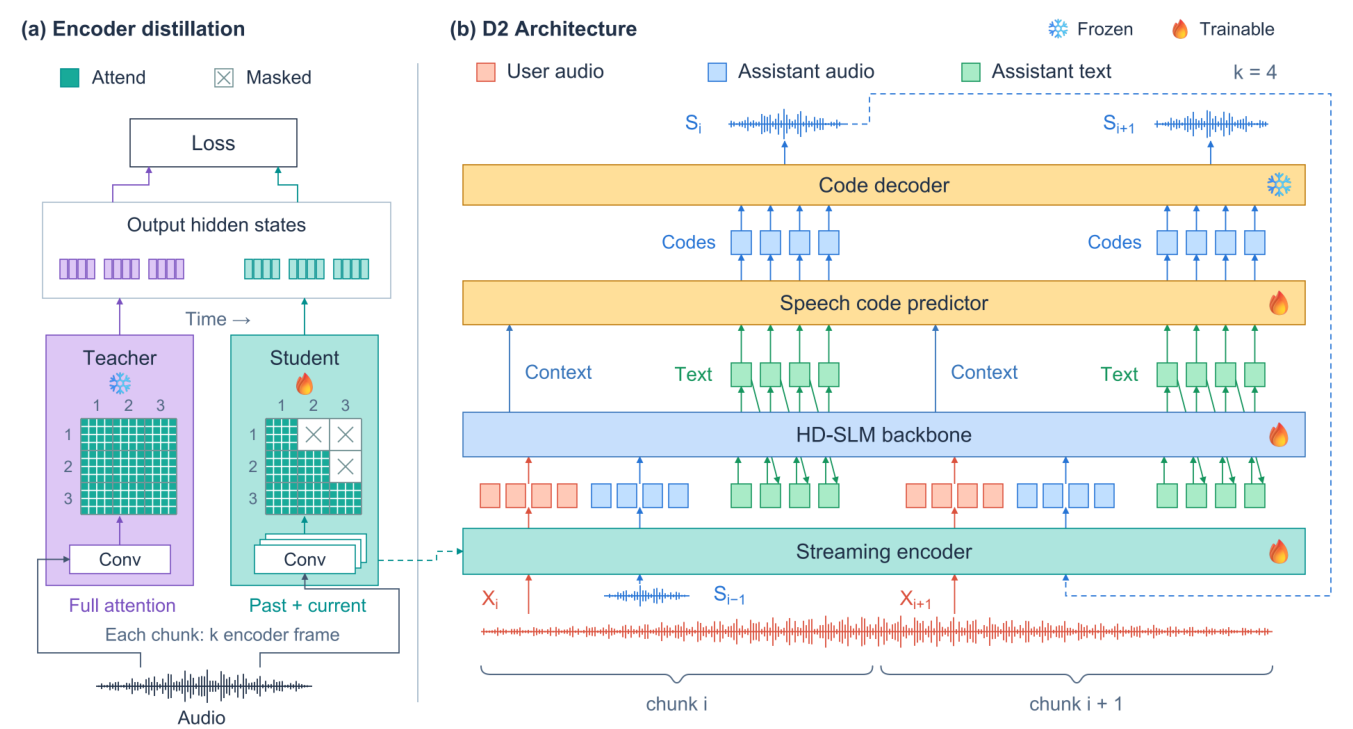
A frozen offline encoder teaches a streaming student. Attention is bidirectional within each chunk and causal across chunks—without a training decoder or transcription labels.
Fine-tune on aligned user and assistant audio, preserving silence and overlap. Each chunk combines current user audio with delayed self-audio feedback to generate the next output.
Smaller chunks give the model more frequent opportunities to listen and respond. Explicit control tokens learn when to begin a response or stop for an interruption.
03 / Results
Compare full- and half-duplex models,
then explore D2’s chunk-size trade-offs.
Qwen3-Omni-D2LLaMA-Omni 2-D2Other full-duplex modelsHalf-duplex models
At 80 ms, Qwen3-Omni-D2 scores 70.1 on VoiceBench, with 521 ms turn-taking latency and 21.3% pause-handling success.
| Model | Interaction | Chunk size | VoiceBench | FD-Score |
|---|
| Model | Chunk | VoiceBench | Turn taking | TT latency | Interruption | Int. latency | Pause success |
|---|---|---|---|---|---|---|---|
| Qwen3-Omni-D2 | 80 ms | 70.1 | 99.2% | 521 ms | 99.5% | 403 ms | 21.3% |
| Qwen3-Omni-D2 | 160 ms | 67.8 | 100% | 539 ms | 99.5% | 432 ms | 19.0% |
| Qwen3-Omni-D2 | 320 ms | 71.6 | 100% | 710 ms | 99.5% | 571 ms | 25.5% |
| Qwen3-Omni-D2 | 640 ms | 71.3 | 99.2% | 1,010 ms | 99.5% | 928 ms | 55.1% |
| Qwen3-Omni-D2 | 1,040 ms | 73.0 | 100% | 1,380 ms | 99.5% | 1,300 ms | 61.6% |
| LLaMA-Omni 2-D2 | 100 ms | 34.7 | 100% | 746 ms | 99.5% | 621 ms | 74.5% |
| LLaMA-Omni 2-D2 | 200 ms | 38.1 | 99.2% | 825 ms | 100% | 710 ms | 78.2% |
| LLaMA-Omni 2-D2 | 400 ms | 41.1 | 100% | 1,020 ms | 99.0% | 894 ms | 69.4% |
| LLaMA-Omni 2-D2 | 800 ms | 42.0 | 98.3% | 1,450 ms | 99.0% | 1,320 ms | 70.8% |
VoiceBench uses the first 200 examples from each of nine tasks. Qwen3-Omni-D2 at 80 ms exceeds the strongest evaluated full-duplex baseline by 9.1 points (70.1 vs. 61.0). Full-Duplex-Bench latency is the event-aligned acoustic gap plus chunk duration; it excludes computation and network time.
Pause handling remains limited, especially for Qwen3-Omni-D2 with small chunks. D2 also retains a capability gap to its original backbones, and relies on synthetic full-duplex training conversations and sufficiently fast speech synthesis.